
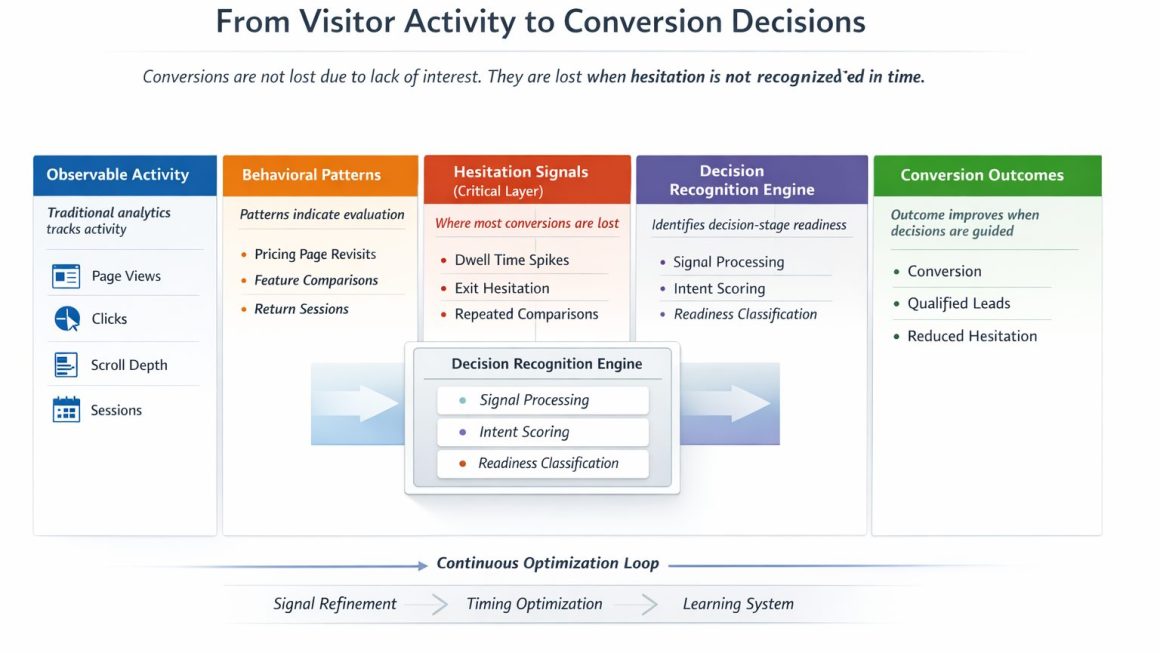
Most websites don’t lose conversions because of poor design.
They lose them in a moment no system tracks.
A visitor lands on your website.
They open your pricing page.
They compare two plans.
They pause.
They don’t ask a question.
They don’t fill a form.
They leave.
Not because they weren’t interested.
Because no one recognized they were deciding.
This AI conversion case study reveals what happens when that moment is finally detected—and acted on.
Concept Snapshot
Concept: Proactive Conversion Intelligence
Definition:
The ability to identify buyer hesitation through behavioral signals and intervene in real time before the decision is lost.
Why it matters:
- Buyers rarely declare intent directly
- Decisions form silently across sessions
- Traditional systems react too late
- Missed hesitation leads to revenue leakage
Key signals:
- Repeated pricing page visits
- Feature comparison behavior
- Multi-session return patterns
- Drop-offs after evaluation pages
Why Proactive Conversion Intelligence Exists
Modern buying journeys are not linear.
They are:
- multi-session
- self-guided
- comparison-driven
- hesitation-heavy
Yet most systems are built to measure:
- clicks
- sessions
- engagement
Not decisions.
Analytics tells you what happened.
It does not tell you:
👉 “Was this visitor about to convert—or about to leave?”
That gap is where conversions disappear.
What Most Teams Get Wrong About Conversion
Misconception 1: Engagement equals intent
Engagement measures activity—not readiness.
Misconception 2: Chatbots solve conversion gaps
Chatbots wait for questions.
Buyers hesitate before they ask anything.
Misconception 3: Conversion is a funnel problem
Conversion loss happens during evaluation—not inside the funnel.
The Invisible Breakdown: Where Decisions Were Lost
Before Proactive AI (Decision Breakdown Timeline)
On Day 1, the visitor explores the homepage.
On Day 2, they return and open the pricing page.
They compare two plans.
They check integrations.
They revisit feature pages.
They pause for 48 seconds.
They leave.
No system responds.
By Day 3, they’ve already chosen a competitor.
Analytics conclusion: no conversion
Decision reality: lost at the hesitation stage
The Behavioral Signals That Revealed the Truth
The shift began when the company stopped tracking activity—and started tracking decision behavior.
Instead of asking:
- “What did the visitor do?”
They asked:
- “What does this behavior indicate?”
Key Decision Signals Identified
- Pricing page dwell time exceeding 45 seconds
- Repeated plan comparison patterns
- Multi-session return within 48 hours
- Exit from evaluation-stage pages
These signals indicated:
👉 This visitor is deciding—not browsing.
System Model: Conversion Decision Recognition Loop
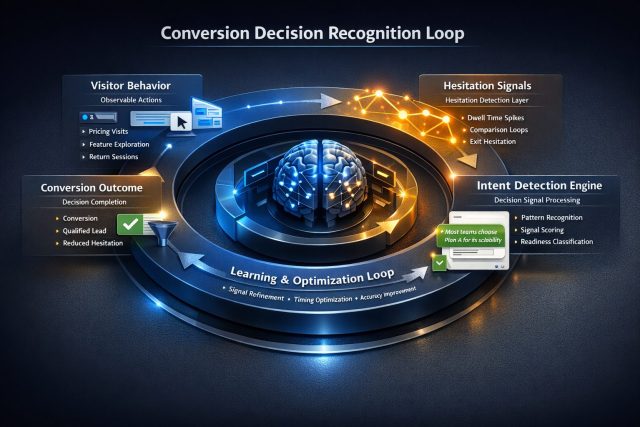
How to Read This Diagram
How to read this diagram:
This visual represents how modern websites should operate—not as passive interfaces, but as decision recognition systems.
Follow the loop step by step:
1. Visitor Behavior (Starting Point)
Every journey begins with observable actions:
- Pricing page visits
- Feature exploration
- Repeat sessions
👉 These are not random actions—they are early decision signals
2. Hesitation Signals (Detection Layer)
As users evaluate, uncertainty appears:
- Dwell time spikes
- Comparison loops
- Exit hesitation
👉 This is the critical moment where most websites fail
Because traditional systems don’t interpret hesitation.
3. Intent Detection Engine (Decision Intelligence Layer)
This is where proactive AI operates:
- Pattern recognition
- Signal scoring
- Readiness classification
👉 The system determines:
Is this visitor exploring, evaluating, or ready to decide?
4. Real-Time Intervention (Action Layer)
Instead of waiting, the system acts:
- Contextual prompts
- Plan recommendations
- Demo nudges
👉 This is the shift from reactive engagement → proactive decision guidance
5. Conversion Outcome (Result Layer)
Possible outcomes include:
- Conversion
- Qualified lead
- Reduced hesitation
👉 Even non-conversions generate decision intelligence
6. Learning & Optimization Loop (Feedback System)
The system continuously improves:
- Refines signals
- Optimizes timing
- Increases accuracy
👉 Over time, this reduces:
- Decision friction
- Conversion variability
- Revenue leakage
Key Insights
Most websites track what users do.
Decision Intelligence systems understand why they hesitate and when they are ready to decide.
What Had to Change Before the 32% Lift Happened
This was not just a tool implementation.
It required operational changes.
1. Signal Threshold Definition
Not every visitor qualifies.
The system defined:
- minimum dwell time thresholds
- repeat behavior conditions
- multi-session patterns
This reduced noise.
2. False Positive Reduction
Early tests triggered interventions too often.
Result:
- user distraction
- reduced trust
The system refined:
- when NOT to intervene
- which behaviors indicate real hesitation
3. Intervention Timing Logic
Timing was critical.
Too early → intrusive
Too late → irrelevant
Optimal timing:
👉 during decision pause moments
4. Page-Level Context Mapping
Different pages required different interventions:
- pricing → plan clarification
- integrations → compatibility reassurance
- features → differentiation
How Proactive AI Changed the Outcome
The same visitor returns.
They open the pricing page again.
They compare plans.
They pause.
This time, the system responds:
“Most teams comparing these plans choose X because of Y.”
The hesitation is resolved.
The decision happens—on your website.
Behavioral Shifts Observed After Implementation
After deploying proactive AI:
- Visitors moved faster through evaluation stages
- Comparison loops reduced significantly
- Return visits converted sooner
- Drop-offs during decision-making decreased
Buyer Thought Pattern Shift
Before:
“I’ll check later.”
After:
“This answers my question now.”
The Measurable Impact: +32% Conversion Increase
Within 60 days:
- +32% increase in conversion rate
- Higher conversion from repeat visitors
- Reduced evaluation-stage abandonment
- Improved lead quality entering pipeline
Where the Lift Came From
- pricing page hesitation resolution
- faster comparison clarity
- reduced decision delays
- intervention during high-intent sessions
This was not random uplift.
It was captured decision intent.
When Proactive AI Will NOT Improve Conversion
This model is not universal.
It performs poorly when:
- traffic is low or unqualified
- visitors are in early exploration (no intent signals)
- signals are misinterpreted as intent
- interventions are generic or mistimed
Hidden Risk
Over-intervention can:
- reduce trust
- interrupt flow
- create friction instead of clarity
Key Insight
Conversions are not lost because users aren’t interested.
They are lost because hesitation is invisible—and traditional systems only track activity, not decisions.
What This Means for Conversion Strategy
This case study changes how conversion should be understood.
It is not about:
- optimizing pages
- increasing traffic
- improving UI
It is about:
- detecting hesitation
- understanding evaluation patterns
- acting during decision formation
Practical Interpretation for Businesses
To apply this:
- Shift from activity tracking → decision tracking
- Identify hesitation thresholds
- Trigger interventions based on behavior—not inputs
Because:
👉 Buyers don’t announce decisions
👉 They reveal them through patterns
The Bigger Shift: Decision Intelligence for Websites
This case study connects directly to a broader system.
- The Decision Leakage Model explains where conversions were lost before intervention
- The Decision Velocity Index (DVI) explains how resolving hesitation accelerated decisions
- Hesitation Density explains where uncertainty clustered across sessions
- The Revenue Stability Score explains why conversion became more predictable—not just higher
This is not just conversion improvement.
This is decision system optimization.
Final Takeaway
Most companies try to improve conversion by optimizing what they can see.
This case study proves:
👉 The real problem exists in what they cannot see.
- hesitation
- evaluation
- silent decision-making
This AI conversion case study shows:
When you detect hesitation,
you don’t just improve conversion.
You control where the decision happens.
FAQ (Decision-Stage Focus)
What is an AI conversion case study?
An AI conversion case study shows how behavioral signal detection and real-time intervention improve conversion outcomes.
Why do high-intent visitors leave without converting?
Because their hesitation is not recognized during evaluation, leading them to decide elsewhere.
How does proactive AI improve website conversion?
By identifying decision-stage signals like pricing dwell time and comparison behavior, then intervening before intent disappears.
What is buyer hesitation in conversion?
Buyer hesitation is the silent phase where visitors evaluate options but do not act due to unresolved uncertainty.


