

Most websites help visitors navigate pages.
Very few help them complete decisions.
That gap is why a true decision support system website is now the missing layer in modern digital stacks not a feature, not a chatbot, not another dashboard.
It’s the system that shows up before intent collapses, not after a question is asked.
The Problem: Websites Are Built for Interaction, Not Decisions
Traditional websites are optimized around visible actions:
- Page views
- Clicks
- Forms
- Chats
These are interaction artifacts, not decision signals.
By the time a visitor asks a question or clicks “Contact Sales,” the decision has already moved forward or backward.
What’s missing is website decision intelligence: a system that understands how decisions form when no one is talking.
Why Reactive Systems Fail at the Decision Stage
Reactive systems are structurally limited:
- They wait for explicit input
- They respond after hesitation
- They activate once confidence is already decaying
This creates a silent failure mode:
- Pricing revisits look like “interest”
- Comparison loops look like “engagement”
- Hesitation looks like “nothing happening”
A common pattern:
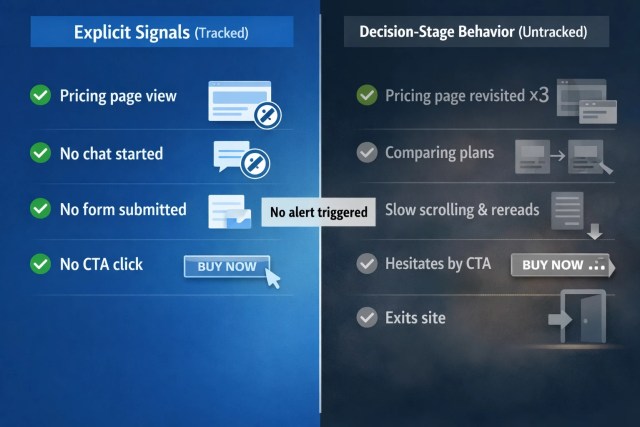
A visitor returns to pricing three times, compares plans, pauses on the CTA, and exits.
No form. No chat. No alert.
The dashboard reports “healthy traffic.”
The decision, however, quietly moved to no.
This is where conversion decision support is supposed to exist and usually doesn’t.
How to read this image
Left: Explicit actions analytics capture — clicks, forms, chats. Everything looks normal.
Right: Evaluation-stage behaviors where decisions actually tilt — revisits, comparisons, hesitation — without triggering any signal.
This image explains, at a glance, why reactive systems fail without ever appearing broken.
What a Decision-Support System Actually Does
A decision support system website does not push, persuade, or interrupt.
It stabilizes decisions.
At a system level, it is designed to:
- Detect evaluation-stage behavior
- Identify hesitation before abandonment
- Support confidence without demanding interaction
This is buyer decision support, not engagement optimization.
The Four Layers of a Website Decision-Support System
1. Behavioral Signal Recognition (Not Events)
Decision-support systems prioritize patterns, not clicks:
- Repeated pricing page returns
- Slow scrolls and rereads
- Feature comparison loops
- Exit-adjacent pauses
These behaviors signal decision risk, not readiness.
2. Intent Interpretation (Without Forcing Conversation)
Intent doesn’t always want to talk.
An intent-based system:
- Reads behavior contextually
- Interprets evaluation signals quietly
- Avoids forcing chat, forms, or popups
This is where intent-based systems diverge from reactive engagement.
3. Decision-Stage Support (Not Persuasion)
Support at this stage looks like:
- Clarifying trade-offs
- Reinforcing value boundaries
- Reducing perceived risk
Not urgency.
Not discounts.
Not “Can I help you?”
Decision-stage support exists to stabilize confidence, not accelerate action.
At this moment, buyers are not asking what the product does.
They are weighing whether choosing it is safe.
Effective decision support:
- Makes constraints explicit instead of hiding them
- Surfaces implications instead of pushing benefits
- Removes ambiguity without demanding interaction
Persuasion interrupts decision-making.
Support aligns with it.
This is conversion decision support — ensuring the decision doesn’t collapse quietly due to unresolved doubt, not forcing it to happen faster.
How to read this image
Left: Buyers evaluate quietly through behaviors like pricing revisits and plan comparisons — without asking questions or triggering interactions.
Center: Confidence erodes gradually during evaluation. No alert fires. No metric changes. The decision weakens without being recorded.
Right: Revenue impact appears later — lost pipeline, stalled deals, delayed conversion drop-off — disconnected from the behaviors that caused it.
Key takeaway:
This image shows why outcome awareness must exist before conversion metrics change. Decision-support systems operate in the middle — where confidence fades but dashboards stay calm.
This is what a decision-support system looks like when a website is built for how buyers decide, not how tools expect them to act.

4. Outcome Awareness (Revenue, Not Engagement)
A real decision-support system connects behavior to economic outcomes:
- Which hesitation patterns precede lost pipeline?
- Where does confidence erode before exit?
- Which decisions stall without ever converting?
This layer exposes revenue leakage long before conversion metrics drop.
Engagement Systems vs Decision-Support Systems
| Engagement Systems | Decision-Support Systems |
|---|---|
| Optimize clicks | Stabilize decisions |
| Measure activity | Interpret behavior |
| React to questions | Act before intent decays |
| Track conversations | Protect outcomes |
Engagement feels productive.
Decision support is protective.
Why This Layer Has Been Missing Until Now
Most digital systems evolved around what was easy to measure:
- Events
- Funnels
- Conversations
Decision-making is quiet, internal, and non-linear — so it was ignored.
But in modern buying environments, waiting is no longer neutral.
Reactive systems don’t just miss opportunities.
They allow decisions to collapse unattended.
The Strategic Shift: From Pages to Decisions
Modern websites should be evaluated by a different question:
Does this system help visitors decide — or just browse?
A decision support system website is not a redesign.
It’s not another widget.
It’s a system-level upgrade that aligns digital experience with how buyers actually decide.
FAQs
What is a decision support system on a website?
A decision support system supports evaluation-stage confidence using behavioral signals — without requiring explicit interaction.
How is this different from chatbots or live chat?
Chatbots respond to questions. Decision-support systems act before questions exist.
Does decision support replace engagement tools?
No. It precedes them. Engagement handles surfaced intent. Decision support protects intent before it surfaces.
Why don’t analytics dashboards show decision loss?
Dashboards track actions, not conviction. Decisions fail silently — without events.
Can decision support work without personal data?
Yes. Decision support operates on behavioral patterns, not identity. It focuses on how decisions form, not who the buyer is.
Decision-support systems don’t increase noise.
They reduce silent loss — before conversion ever becomes a metric.


